




Food manufacturing facilities face demanding floor-cleaning conditions. Grease, protein, food particles, flour, sugar, oil, and liquid spills can quickly create slippery and difficult-to-clean surfaces.
Unlike general industrial environments, food processing facilities also need to consider hygiene, cross-contamination, wastewater recovery, and the cleanliness of the cleaning equipment itself.
Choosing the right floor scrubber therefore requires more than comparing cleaning width or maximum cleaning capacity. The machine should match the floor, contamination type, cleaning process, and sanitation requirements of the facility.
What Contaminants Are Common in Food Manufacturing?
Different food production environments create different types of floor contamination.
Common examples include:
- Grease and oil: Common in meat, poultry and some prepared-food facilities.
- Protein and organic residues: Often found in meat, dairy and food-processing areas.
- Flour and powder: Common in bakeries and ingredient-processing areas.
- Sugar and syrup: Frequently found in beverage and confectionery production.
- Food particles: Crumbs, small food pieces and production residue.
- Water and liquid spills: Common in areas with frequent washing and production activities.
The cleaning method should be selected according to the type and amount of contamination rather than using the same process throughout the entire facility.
What Makes a Floor Scrubber Suitable for Food Processing?
A suitable scrubber-dryer should provide effective floor cleaning while also supporting good hygiene and maintenance practices.
Key factors include:
Easy-to-clean tanks and components
Solution and recovery tanks can come into contact with cleaning chemicals, dirty water and food residues. Easy access makes it simpler for operators to empty, rinse and inspect the machine after use.
Some scrubber-dryers are also available with tanks made from antibacterial materials. These materials are designed to reduce the development of bacterial and fungal growth on tank surfaces, helping improve machine hygiene and reduce odour development.
This type of feature can be particularly useful in food-processing environments where equipment hygiene is an important part of the cleaning program.
Effective wastewater recovery
Food-processing floors are often wet and may have high levels of foot traffic. Poor water recovery can leave the floor slippery and increase drying time.
A properly adjusted squeegee and effective vacuum system should remove wastewater during the cleaning pass, helping leave the floor cleaner and drier.
Suitable brushes and pads
The brush or pad should match both the floor surface and the type of contamination.
Using unnecessarily aggressive brushes can increase floor wear, while insufficient mechanical action may not remove heavy deposits effectively.
Chemical control
Cleaning chemicals should be compatible with the floor, machine and facility’s sanitation procedures.
Accurate detergent dosing can also help maintain consistent cleaning performance while avoiding unnecessary chemical use.
Disc vs. Cylindrical Scrubbing Systems
There is no single scrubbing system that is best for every food-processing facility.
Disc Scrubbers
Disc systems use flat rotating brushes or pads that provide direct contact with the floor.
They are particularly suitable for:
- Smooth epoxy or resin floors
- Heavy grease and soil
- Areas requiring strong mechanical scrubbing
- Facilities where loose debris is limited
If large amounts of dry food debris are present, the floor should generally be swept or vacuumed before scrubbing.
Cylindrical Scrubbers
Cylindrical systems use roller-shaped brushes that scrub the floor while also helping collect smaller loose particles.
They can be useful for:
- Textured or uneven floor surfaces
- Floors with grout lines
- Mixed dry and wet contamination
- Areas where food particles are present
- Applications where reducing pre-sweeping can improve productivity
For facilities with significant amounts of loose dry waste, however, a dedicated sweeper or vacuum cleaner may still be the better first step.
Which system should you choose?
| Application | Recommended approach |
| Smooth floor with heavy grease | Disc scrubbing |
| Liquid + small food particles | Cylindrical scrubbing |
| Large amount of dry food waste | Sweep or vacuum first |
| General routine cleaning | Select according to floor and contamination |
The correct choice depends on the complete cleaning process, not simply on the brush type.
Cleaning Different Food Manufacturing Areas
Different food industries require different cleaning approaches.
Bakery and Flour Processing
Typical contamination includes flour, powder, dough and food particles.
Loose dry debris should be removed before wet cleaning when present in large quantities. Cylindrical scrubbing can be useful when smaller particles remain on the floor together with liquid contamination.
Meat and Poultry Processing
Floors may contain grease, protein residues, organic material and large amounts of water.
The cleaning process may require an appropriate detergent, sufficient contact time and strong mechanical scrubbing, followed by effective wastewater recovery.
Dairy Processing
Milk, fat and protein residues can create slippery surfaces.
The cleaning system should provide effective soil removal and reliable water recovery while being compatible with the facility’s established cleaning procedures.
Beverage and Food Production
Sugar, syrup and liquid spills can create sticky or slippery surfaces.
Consistent detergent dosing and controlled water usage can help maintain repeatable cleaning performance.
Chemical Dosing for Consistent Cleaning
In food manufacturing, detergent concentration should be controlled according to the cleaning task and chemical manufacturer’s recommendations.
An automatic chemical dosing system can help reduce manual mixing and improve consistency.
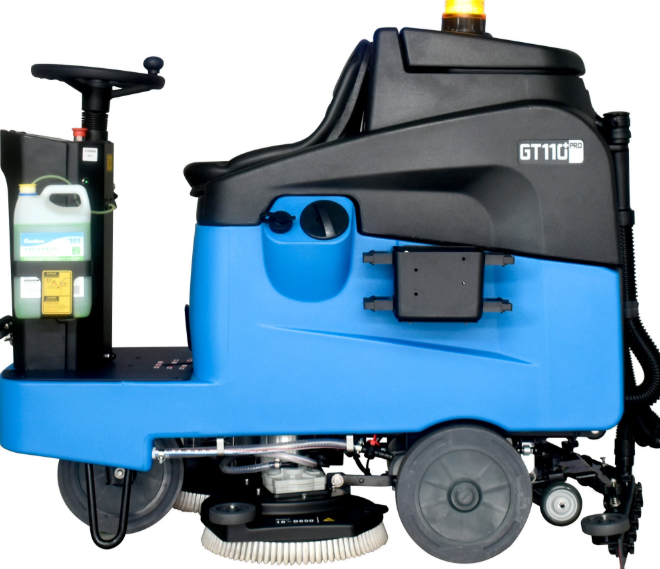
Gadlee’s EDS Chemical Dose System precisely mixes water and detergent and provides three dilution settings for different cleaning applications. Its quick-change detergent design also helps reduce unnecessary water waste during detergent changes.
For food-processing applications, this can be useful when different cleaning conditions require different detergent concentrations.
The detergent itself should always be selected according to the type of soil, floor material and the facility’s sanitation procedure.
Preventing Cross-Contamination
Cleaning equipment should be considered part of the overall hygiene process.
In facilities with different hygiene zones, operators should consider measures such as:
- Using dedicated or colour-coded brushes and accessories
- Avoiding unnecessary movement of cleaning equipment between high- and low-risk areas
- Following the facility’s established cleaning sequence
- Cleaning and rinsing the machine after use
- Emptying the recovery tank after each cleaning cycle
- Inspecting hoses, squeegees and brushes regularly
The exact procedure should follow the facility’s food safety and sanitation program.
A floor scrubber supports the cleaning process; it does not replace the facility’s sanitation procedures or food safety controls.
How to Clean a Food Manufacturing Floor
A typical cleaning process may include the following steps:
Remove loose debris
Sweep or vacuum flour, food particles and other dry waste where necessary.
Apply the appropriate cleaning solution
Use a detergent suitable for the contamination and floor material.
Allow sufficient contact time
For heavy grease or protein-based contamination, follow the chemical manufacturer’s recommended contact time.
Scrub the floor
Use the appropriate brush, pad, pressure and cleaning speed.
Recover wastewater
The scrubber-dryer should remove contaminated water effectively to reduce slip risk and drying time.
Clean the machine
Empty and rinse the recovery tank and clean the squeegee, hoses, brushes and other components according to the machine maintenance procedure.
This process helps keep both the floor and the cleaning equipment under control.
Walk-Behind or Ride-On Scrubber?
Machine size should be based on the actual cleaning route rather than facility size alone.
Walk-Behind Scrubbers
Suitable for:
- Narrow production areas
- Smaller processing rooms
- Areas around machinery
- Corridors and confined spaces
- Facilities with many obstacles
Ride-On Scrubbers
Suitable for:
- Large production floors
- Open processing areas
- Warehouses and distribution areas
- Long cleaning routes
- Facilities with limited sanitation windows
Large facilities may benefit from using both. A ride-on machine can clean large open areas efficiently, while a compact walk-behind machine can handle narrow spaces and areas around production equipment.
よくあるご質問
What is the best floor scrubber for a food manufacturing facility?
There is no single machine that is best for every facility. The choice depends on floor type, contamination, cleaning area, available cleaning time, hygiene requirements and the amount of loose debris.
Can a floor scrubber pick up food debris?
Cylindrical scrubbers can collect smaller loose particles while scrubbing. However, large quantities of dry food waste should generally be removed with a sweeper or vacuum before wet cleaning.
Is a disc or cylindrical scrubber better for food processing?
Disc systems are well suited to smooth floors and heavy mechanical scrubbing. Cylindrical systems can be advantageous when floors are textured or contain a mixture of liquid and small solid debris.
How do you clean grease from a food-processing floor?
Use a suitable cleaning chemical according to the chemical manufacturer’s instructions, allow the required contact time, mechanically scrub the floor and recover the wastewater effectively.
Can a scrubber-dryer help reduce cross-contamination?
A scrubber-dryer can support a facility’s hygiene program, but cross-contamination control also depends on cleaning procedures, equipment management, zoning and the use of appropriate accessories.
Are antibacterial tanks useful for food manufacturing?
Scrubber-dryers with tanks made from antibacterial materials can help reduce bacterial and fungal growth on tank surfaces and improve machine hygiene. They do not replace regular tank cleaning, rinsing and maintenance.
What detergent should be used in a food manufacturing facility?
The detergent should be selected according to the type of contamination, floor material, machine and the facility’s established sanitation procedure. For automatic scrubber-dryers, low-foaming products are generally preferred to support effective wastewater recovery.
For more comprehensive answers on equipment operation and maintenance, visit our FAQ page.
Conclusion
Choosing a floor scrubber for food manufacturing is not simply a matter of selecting the largest machine or the highest cleaning capacity.
A suitable solution should match the floor, contamination, cleaning process, hygiene requirements and available sanitation time.
Disc or cylindrical brushes, effective water recovery, easy-to-clean components, antibacterial tank materials and accurate chemical dosing can all contribute to a more consistent cleaning process.
Most importantly, the scrubber should work as part of the facility’s overall sanitation program—from removing food debris and applying the correct cleaning solution to mechanical scrubbing, wastewater recovery and machine maintenance.
 English
 Chinese
 German
 French
 Spanish
 Japanese