




Selecting the appropriate sweeper is a critical operational decision that directly impacts cleaning efficiency, labor input, and long-term operating cost. Rather than focusing solely on size or price, professional cleaning equipment selection should be guided by area coverage, debris type, terrain conditions, and frequency of use.
Gadlee offers two complementary sweeping solutions within this segment:
- GTS920M, a fully mechanical manual sweeper, designed for light-to-medium debris collection in confined or obstacle-dense areas
- GTS1200, a compact ride-on sweeper, engineered for high productivity and sustained operation in large professional environments
While both machines employ a mechanical sweeping principle with brush-and-hopper systems, they serve distinctly different operational needs. This comparison outlines their technical positioning and ideal applications to support informed purchasing decisions.
1. GTS920M: Manual Sweeper for Flexible, Low-Cost Maintenance
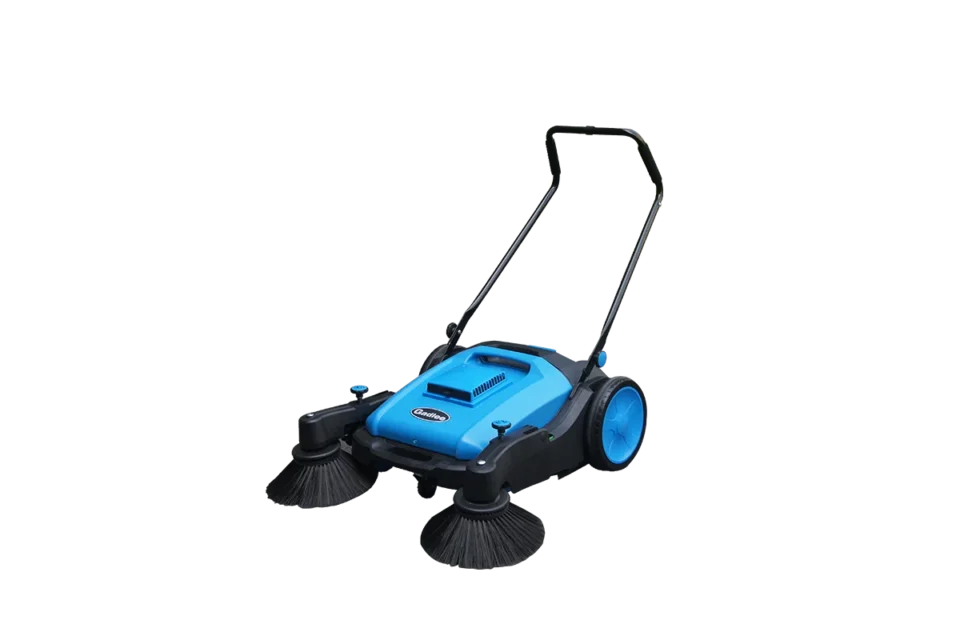
En Gadlee GTS920M is a manual sweeper, driven entirely by mechanical transmission generated through operator movement. It is not a powered walk-behind machine and does not rely on batteries, motors, or vacuum systems. Its design prioritizes simplicity, portability, and zero operating cost.
Key Technical Specifications and Implications
| Parameter | GTS920M | Operational Implication |
| Sweeping Width | 920 mm | Wide coverage for a manual sweeper, suitable for corridors and open flat areas |
| Theoretical Productivity | 1,840 m²/h | Multiple times faster than broom sweeping for routine maintenance |
| Hopper Capacity | 40 L | Suitable for light to medium debris loads |
| Maximum Climbing Ability | 2% | Designed for flat surfaces only |
| Power System | Fully mechanical | No fuel, battery, or electrical dependency |
| Net Weight | 21 kg | Lightweight, easy to transport and store |
The purely mechanical system enables silent operation, making the GTS920M suitable for noise-sensitive environments. It effectively collects coarse debris such as sand, stones, leaves, paper scraps, and glass fragments on both indoor and outdoor surfaces.
Recommended Usage Scenarios
The GTS920M is best suited for supplementary or routine sweeping where flexibility and cost control are more critical than speed.
Typical Applications
- Office buildings and corridors
- Workshops and light industrial areas
- Residential complexes and property maintenance
- Parking access lanes, sidewalks, courtyards, and outdoor walkways
- Facilities with limited storage space or infrequent sweeping needs
It is particularly effective in obstacle-rich environments where larger powered machines lack maneuverability. However, due to its manual nature, it is not intended for large-area or high-frequency commercial cleaning.
2. GTS1200: Compact Ride-On Sweeper for High-Productivity Operations
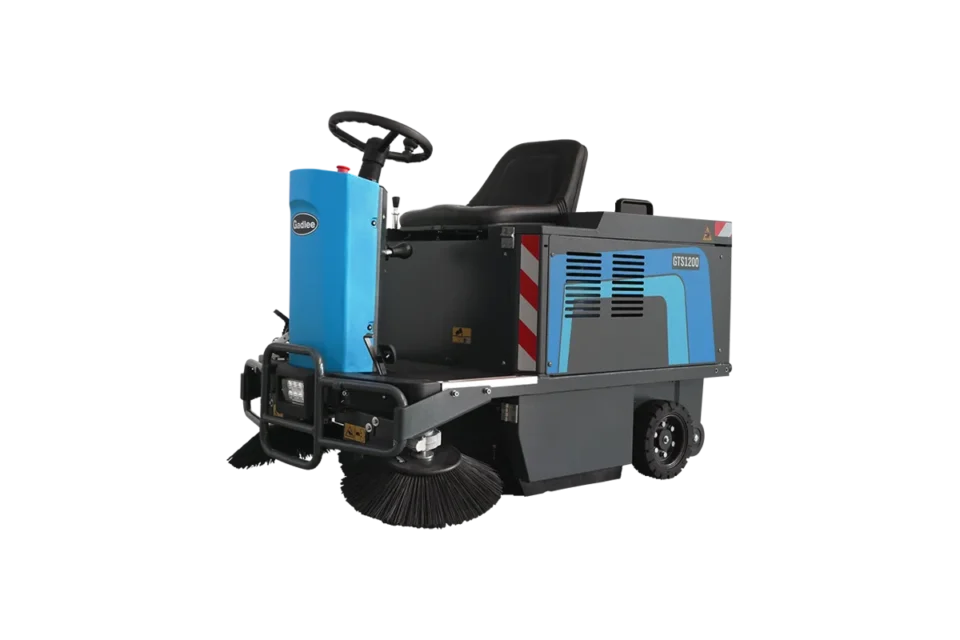
En Gadlee GTS1200 is a battery-powered ride-on sweeper, designed for professional users managing large areas and continuous cleaning schedules. It integrates sweeping, dust filtration, and operator comfort into a compact yet industrial-grade platform.
Key Technical Specifications and Implications
| Parameter | GTS1200 | Operational Implication |
| Sweeping Width | 1,200 mm | High coverage efficiency, fewer passes required |
| Theoretical Productivity | 7,200 m²/h | Suitable for large-scale professional cleaning |
| Hopper Capacity | 70 L | Reduced downtime for emptying |
| Maximum Climbing Ability | 16% | Effective on ramps, car parks, and loading docks |
| Power System | 24V battery | Emission-free indoor and outdoor operation |
| Runtime | Approx. 3–5 hours | Supports continuous cleaning shifts |
| Filter Area | 4 m² PTFE filter | Excellent fine-dust control with electric filter shaker |
The heavy-duty PTFE filtration system ensures high dust retention efficiency, particularly in industrial environments where fine dust is prevalent. The steel chassis and robust body construction provide long-term durability under demanding conditions.
Recommended Usage Scenarios
The GTS1200 is designed for high-throughput sweeping where productivity, endurance, and operator efficiency are essential.
Typical Applications
- Factories and production facilities
- Warehouses and logistics centers
- Commercial and multi-story car parks
- Airports, terminals, and service areas
- Large outdoor or semi-outdoor industrial zones
Its ride-on configuration significantly reduces operator fatigue and improves consistency during long cleaning cycles.
3. Operational Comparison: Scale, Productivity, and Cost Efficiency
Configuration and Operation
| Feature | GTS920M (Manual Sweeper) | GTS1200 (Ride-On Sweeper) |
| Drive System | Manual push | Electric traction |
| Operator Fatigue | Higher | Significantly reduced |
| Dust Control | Mechanical collection | PTFE filtration + shaker |
| Construction | Lightweight | Industrial-grade steel frame |
Coverage and Productivity
The GTS1200 delivers nearly four times the productivity of the GTS920M, making it the ideal choice for cleaning large areas spanning several thousand square meters with maximum efficiency and minimal labor input. Its high-capacity design enables faster area coverage and consistent results across expansive sites. In comparison, the GTS920M excels in maneuverability, offering a practical and cost-effective solution for narrow aisles, cluttered spaces, and confined environments where larger ride-on sweepers are not required.
Cost Considerations
GTS920M
- Low purchase cost
- Zero energy consumption
- Minimal maintenance
- Higher labor input per square meter
GTS1200
- Higher initial investment
- Battery charging and maintenance required
- Significantly lower labor cost per m² cleaned
4. Conclusion: Matching the Sweeper to the Task
The comparison between Gadlee GTS920M and GTS1200 reflects two fundamentally different cleaning strategies.
- GTS920M is a practical, manual sweeping solution for light-duty maintenance, confined areas, and facilities prioritizing simplicity and low ownership cost.
- GTS1200 is a professional ride-on sweeper engineered for high-volume, industrial, and large-area cleaning where productivity, endurance, and operator comfort are critical.
Choosing the right model depends on area size, debris type, terrain conditions, and cleaning frequency. Aligning the sweeper’s design intent with real operational demands ensures maximum efficiency, controlled costs, and consistent cleaning results.
 English
 Chinese
 German
 French
 Spanish
 Japanese