




In professional floor cleaning operations, choosing between a sweeper and a scrubber-dryer is a critical decision that directly affects cleaning efficiency, operating costs, and hygiene standards. Although both machines are widely used in industrial, commercial, and public environments, they are designed to address different types of contamination.
A sweeper is engineered for the efficient collection of dry debris and dust, while a scrubber-dryer is designed for wet cleaning, combining mechanical scrubbing with chemical action and immediate water recovery. Understanding the structural principles, operating mechanisms, and application boundaries of each machine is essential for selecting the right solution—or the right combination—for your facility.
This guide provides a clear, professional comparison based on equipment structure, cleaning principles, and real-world application scenarios.
The Dry Cleaning Specialist: Sweeper
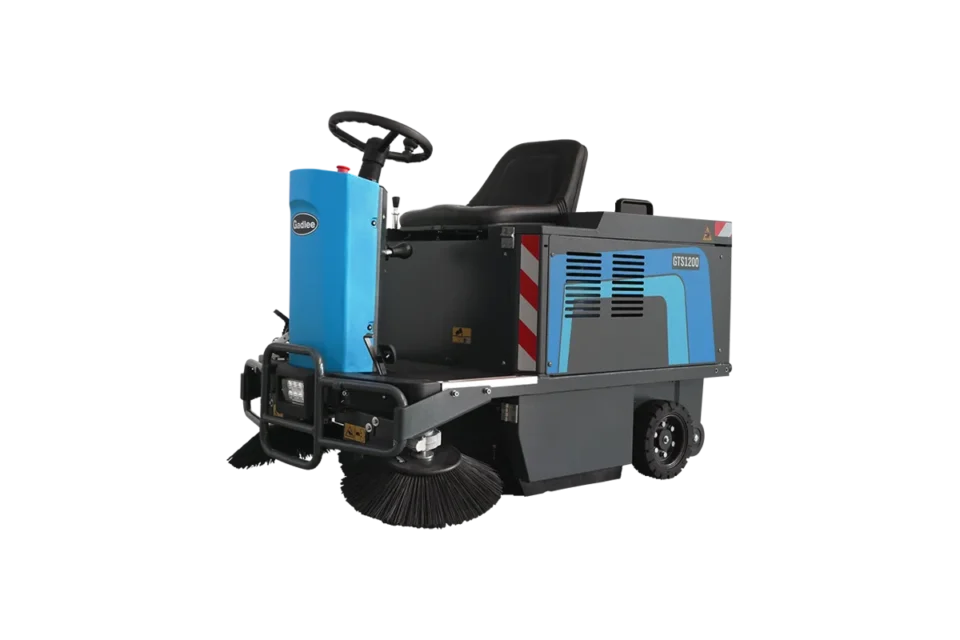
A sweeper is a mechanical cleaning machine designed to collect dry debris and airborne dust from hard floor surfaces, both indoors and outdoors. Its primary role is to leave floors physically clear while maintaining dust control.
Equipment Structure and Working Principle
Sweeping System
The sweeping system is the core of the machine and typically consists of:
- One or more side brushes, which guide scattered debris toward the cleaning path
- A central cylindrical brush, which mechanically lifts and conveys debris into the hopper
Depending on the machine design, debris collection follows either an overthrow or direct-throw principle, both widely used in professional sweepers.
Vacuum System and Filtration
Dust control is achieved through a controlled airflow system:
- A fan creates negative pressure (airflow) in the sweeping area and hopper
- Fine dust is drawn through a filter system, preventing it from escaping into the environment
- A filter shaker (manual or electric) periodically cleans the filter by shaking accumulated dust into the hopper
This system is essential for maintaining air quality, especially when handling fine dust in industrial or enclosed environments.
Operating Formats
Sweepers are available as:
- Walk-behind models, ideal for confined or obstacle-dense areas
- Ride-on models, designed for large open spaces and high productivity
Applicable Floor Types and Typical Applications
Sweepers are suitable for dry, hard floor surfaces where debris is solid and non-sticky.
| Applicable Floor Types | Typical Applications |
| Concrete, Asphalt | Warehouses, logistics hubs, parking areas, roads, yards |
| Tiled and industrial hard floors | Production halls, distribution centers, service areas |
Sweepers are particularly effective in environments with bulk dry debris, such as sand, packaging waste, dust, and general industrial residue.
Note: Heavy materials such as metal shavings are typically handled only by specific heavy-duty or front-throw industrial sweepers.
The Wet Cleaning Specialist: Scrubber Dryer
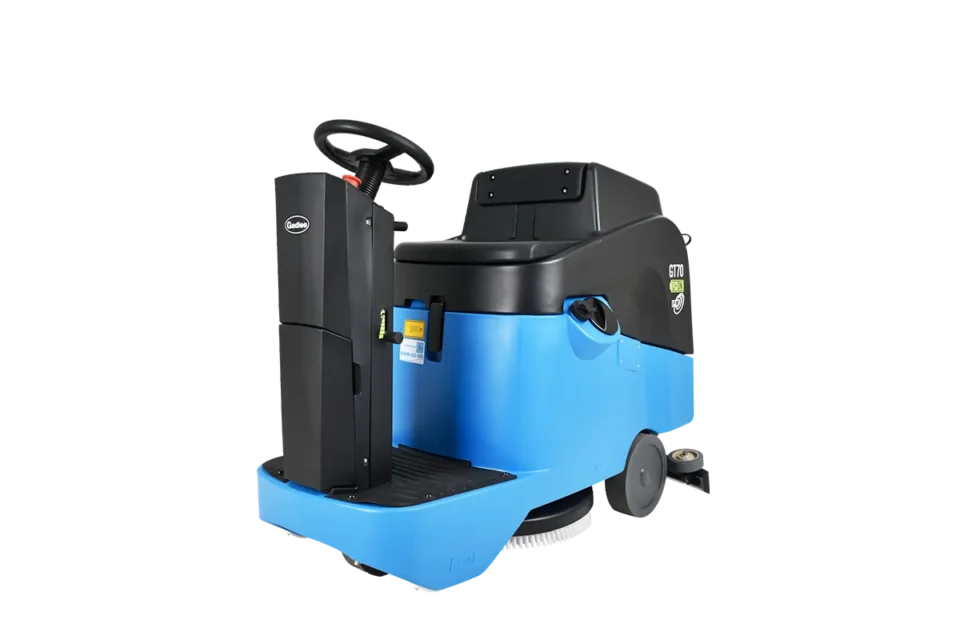
A scrubber dryer is designed to apply cleaning solution, mechanically scrub the floor, and recover dirty water in a single pass, leaving the surface clean and dry.
Equipment Structure and Cleaning Principle
Tank System
Scrubber-dryers use two separate tanks:
- Solution tank for clean water and detergent
- Recovery tank for collecting dirty water
Tank capacity determines operating time and productivity.
Scrubbing System
The scrubbing unit consists of:
- Disc brushes, cylindrical brushes, or pads
- Mechanical pressure and rotation to loosen dirt
Cleaning effectiveness follows the four cleaning factors:
- Chemical action (detergent)
- Mechanical action (brush pressure and friction)
- Temperature
- Time
Drying System
After scrubbing:
- A squeegee collects the dirty solution
- A vacuum motor lifts water into the recovery tank
This allows floors to be reopened quickly, reducing slip risks.
Applicable Floor Types and Typical Applications
Scrubber-dryers are suitable for water-resistant hard floors requiring hygienic cleaning.
| Applicable Floor Types | Typical Applications |
| Ceramic, sealed concrete, stone | Hospitals, shopping malls, airports |
| Vinyl, epoxy, industrial coatings | Schools, offices, public buildings |
Scrubber-dryers are essential for removing oil, grease, dried spills, rubber marks, and sticky residues that cannot be addressed by dry sweeping alone.
- Both sweepers and scrubber-dryers are not recommended for untreated wood floors.
Sweeper vs. Scrubber-Dryer: Key Differences at a Glance
| Feature | Sweeper | Scrubber-Dryer |
| Primary Function | Dry debris and dust collection | Wet scrubbing, rinsing, and drying |
| Cleaning Principle | Mechanical sweeping + airflow filtration | Chemical + mechanical + water recovery |
| Cleaning Medium | Brushes and airflow | Water, detergent, brushes/pads |
| Waste Handling | Dry hopper | Separate solution and recovery tanks |
| Best for | Sand, dust, litter, packaging waste | Oil, grease, stains, liquid residues |
| Typical Use | Pre-cleaning, outdoor and industrial areas | Hygiene-critical indoor environments |
In many industrial environments, both machines are complementary. Sweeping removes bulk debris and dust first, protecting the scrubber-dryer from damage and improving overall cleaning efficiency.
Choosing the Right Machine for Your Operation
When a Sweeper Is the Right Choice
Choose a sweeper when:
- Contamination is dry and loose
- Dust control and air quality are priorities
- Wet cleaning is not permitted or practical
When a Scrubber-Dryer Is Essential
Choose a scrubber-dryer when:
- Sanitary or hygienic cleaning is required
- Floors are affected by grease, stains, or liquid spills
- Fast drying is critical in high-traffic areas
Conclusion
Sweepers and scrubber-dryers serve distinct but complementary roles in professional floor cleaning. Sweepers excel at dry debris removal and dust control, while scrubber-dryers deliver deep, hygienic cleaning with immediate drying. By selecting equipment based on contamination type, floor material, and hygiene requirements, facility managers can implement a cleaning strategy that maximizes productivity, protects equipment, and maintains consistently high cleaning standards.
 English
 Chinese
 German
 French
 Spanish
 Japanese